Showing posts with label plazas. Show all posts

16 June 2012

Madrid & El Escorial

Leaving Ciudad Real and embarking on our travels went pretty smoothly. We have way too many heavy bags, but some how have managed to make it work! I have a ton of updates to relay, but let's start at the begininning of our adventure: in Madrid, for our last few days in Spain. 

We met our friend Ben in Madrid on the 6th of June, and immediately embarked on a whirlwind tour of the city. On Ben's first day in town we saw the Royal Palace, walked all over the historic center of the city, and went to two of the biggest art museums: the Reina Sofia and the Prado. 

Here's Ben and WP in front of the palace. I think this was what they did when I told them to do a "crazy" pose: 


Here are the boys with the Don Quixote and Sancho Panza statue in Plaza España:


And me and Ben in Plaza Mayor: 


I think this was taken in the elevator in the Reina Sofia museum. I'm not sure why they have such serious faces. Art is a serious business?  


On our first night in Madrid we met up with our friend Lucas (Spanish-American friend who lives in Madrid) and we all went out to one of our favorite restaurants in the La Latina neighborhood, Naia Bistro. It was great to get to see Lucas once more before leaving Spain, and he even took some of our extra English-language books off our hands so we could get closer to EasyJet's draconian weight limit for our flight to Rome.  Here's a photo of Lucas and WP in the apartment rental we stayed in for two nights: 


On our second day hanging out with Ben, we took a day trip from Madrid up to the town of El Escorial, about a ninety-minute train ride from Madrid. El Escorial houses a historical palace/monastery complex of the Kings of Spain, and is a short bus ride away from El Valle de los Caídos (the Valley of the Fallen, a controversial Franco-era monument to the deaths of the Spanish Civil War). 

In the town of San Lorenzo de El Escorial, the biggest thing to see is the Royal Monastery; the gigantic complex built by King Philip II, the son of Charles V of the Holy Roman Empire, and the great-grandson of Isabella and Ferdinand (the Spanish monarchs who funded Columbus on his first trip to the New World after recapturing Granada in 1492, the last remaining Muslim kingdom within what is now Spain). The Royal Monastery was the place where Philip ruled the vast Spanish Empire (from Latin America to the Philippines, discovered and conquered by Spanish explorers during his reign, and named after him), containing a huge basilica, library, tombs of the Hapsburg monarchs of Spain, art galleries, and a whole bunch of other rooms and halls. It was a pretty intense walking tour throughout the building over what felt like several miles of winding passageways and staircases, and we got to see some beautiful art, including some amazing original maps from the 1500s showing Spain's idea of what the world looked like back then (Spoiler Alert: they had a lot to learn about the shape of California back then). I think we all particularly enjoyed the library, which has 40,000 books and several old globes. Here's Ben out in front of the complex: 


We weren't allowed to take pictures in most of the building, but one security guard did let me snap this one from inside the building, looking out over the gardens and the foothills of the Sierra de Guadarrama (Guadarrama mountain range):


In addition to El Escorial, people go to this part of Spain to see El Valle de los Caídos, The Valley of the Fallen.  The Valley of the Fallen is a Basilica and a huge memorial built by the Spanish dictator Francisco Franco to honor those who died in the Spanish Civil War in which he seized power. Franco apparently claimed that building this monument was a "national act of atonement", but it is very controversial since he built it using convict laborers, many of whom were prisoners from the war on the Republican side (the legitimate government of Spain, which Franco overthrew in the war), and while working on the monument they were basically treated as slaves. 

They started building the monument in 1940 and finished in 1959. The monument is nestled in a beautiful forested valley about 15 minutes outside the small town of San Lorenzo de El Escorial. There is only one public bus per day, and the website says that the site is closed to tour groups, steps that some people think the authorities took in order to make the monument harder to visit; wanting either to discourage Franco's supporters from coming by to admire his work (and to visit his grave, inside the basilica) or just because the Civil War and the 40-year dictatorship that followed it are still very controversial periods within Spain. We met many people in Ciudad Real who had family members who died or disappeared during the war, and some of them have relatives who still won't talk to each other as a result. Either way, it makes for a very dramatic scene when you pull up and see this 500-foot tall cross: 


The Basilica is built into this hill below the giant cross. From the outside it's hard to tell what it will look like inside, but it has tall domes and arched ceilings like you would see in most churches in Spain, and looks a lot like the basilica inside the Royal Monastery in El Escorial. In fact, Franco saw Philip's time as a golden age for Spain, and by building his memorial so close by and borrowing some of the same architectural style, he was trying to link his regime to the nation's former imperial glory.


The Basilica faces Madrid, and has a beautiful view of the countryside and the city off in the distance: 


Inside the church, we started to get pretty creeped out. A lot of the imagery and statues are pretty dark, and the place is not in the best condition, most likely because they aren't getting a lot of money from the democratic government to keep it up. I wasn't supposed to take photos... but I managed to snap a few anyways. (This is Spain, right? Who needs rules...) The photo on the left is a winged angel with a sword, and on the right there is a door that marks the graves of the Nationalists (Franco's side, made up of religious conservatives and wealthy landowners) who died in the civil war. It says "Fallen. For God and for Spain. 1936-1939. RIP."


Entering the darkness through an archway flanked by two of those winged angels, we felt something like we were entering the Mines of Moria in the Lord of the Rings. Here's the view looking down the corridor of the church before you arrive at the center dome: 
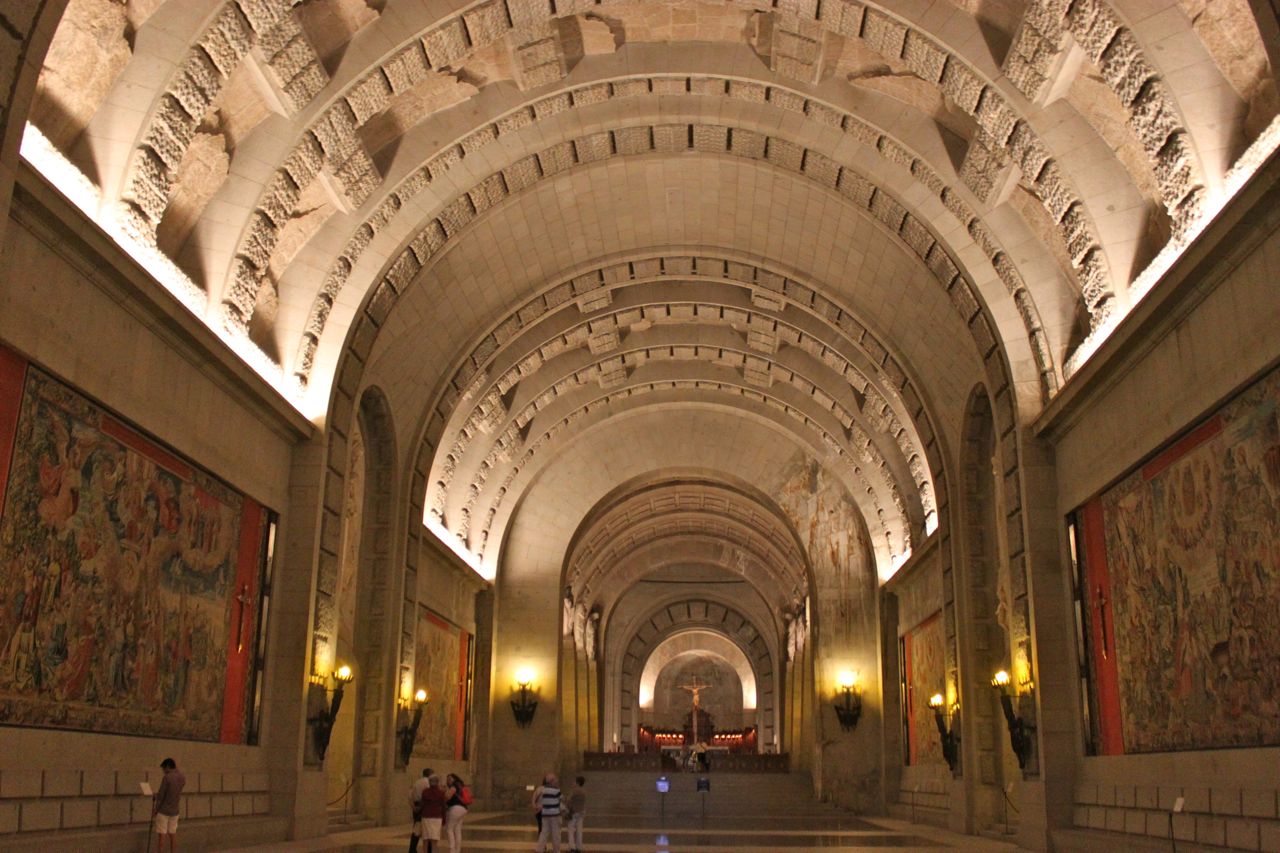

Most of the other visitors (there weren't very many there when we were there) were tourists like us, just interested in seeing a piece of Spain's history. We did, however, see a few people who were there to honor Franco and pay their respects to his grave. Watching them kiss Franco's grave was pretty shocking, and eventually we ran out of there to get some fresh air and distract ourselves from the weirdness of the place while waiting for the bus to take us back to town. We walked up behind the hill to the other side of the cross where there is another monastery and courtyard. This area was actually really peaceful, and since it was a decent walk uphill, we were the only tourists who made it up there. It was a welcome break from being inside the underground basilica. 


In retrospect, spending our last day in Spain at El Escorial may not have been the most cheerful end to our time in the country, but it was definitely an interesting trip through some of the darker and imperialist episodes in the country's history. Fortunately, Spain has changed immensely since Franco's death in 1975. From embracing democracy and tourism to building high-speed trains across the country and joining the EU, the country has come a long way in just a few generations. After riding the train back to Madrid, we spent our last evening hanging out at our favorite vegetarian restaurant there, and then got up early to head to Rome. Stay tuned for pictures and stories of our Italian adventures soon! 

25 April 2012

Lisbon, It Was Nice To Meet You

Last weekend we went to Lisbon, Portugal. It is one of those random places that was never on the top of my travel list, and I'm not quite sure why. Maybe it's just that Portugal is such a small country, or that in Europe there are so many "must-see" places like Paris, London, Barcelona, etc. After having been to Lisbon though, I think it definitely deserves a spot up top with the big boys.  Lisbon is what you would get if you combined Paris (the cafes, bookstores, and overall adorableness), Madrid (the cheap prices, some grunge, good art) and San Francisco (the hills, colorful houses, restaurants).

I think it is only natural that new places you visit will remind you of places you've been before, but when we first arrived, I think the San Francisco feel of Lisbon was especially surprising.  We didn't expect to take an hour-long flight from Madrid and be reminded so much of home! I mean, they have a big red bridge, a bay, hills, and even cable cars. And in addition to all that, they have delicious food, and eclectic buildings. 

Flying into Lisbon I was able to snap this photo of the Ponte 25 de Abril (25th of April Bridge). It actually has two towers like the Golden Gate Bridge, but I couldn't get both in the picture:  


On the way into town on the airport bus we got to see some of the city, including this awesome bull-fighting ring (the ring is awesome, not the fighting of bulls): 


After checking into our swanky hotel (the Sheraton, which was having a 40th anniversary sale, so our room was only €40 a night instead of €160! Thanks to WP's internet deal-finding skills!) we started walking toward the old part of town and ended up seeing some cool murals along the way: 


We also stumbled upon one of the cable cars in the city, called the Elevador da Gloria, and after it filled up with (mostly) tourists, we took it up a pretty steep hill. Here's the cable car: 


When we got to the top of the hill there were some pretty cool views of the city, including the old Moorish castle on the hill across from us: 


That evening we ate some Japanese food and then walked down to the center of the city to check out some more historic buildings. There was actually a big soccer match between Sporting (a Lisbon team) and Atletico Bilbao (a Spanish team from the Basque country), so the downtown area was totally deserted. On the flight from Madrid we were on the plane with a bunch of Bilbao supporters who were all dressed up in red and white jerseys and as soon as we touched down in Lisbon erupted into pro-Bilbao cheers. We assume they were all flying in to actually attend the match, which Portugal ended up winning with two goals late in the game. Here's one of the big empty plazas lit up at night:


On Friday we did some sightseeing around the city, starting with the Mosteiro dos Jerónimos, a pretty big monastery in the part of town called Belém. Here's the main cathedral: 


And the outdoor courtyard of the monastery: 


The stone work was really cool-looking, with lots of spirals and small arches: 


We also happened to be touring alongside a high-school group, which ended up having its benefits. They were learning the history of the monastery from some actors who kept changing costumes and singing songs. They were speaking Portuguese, so we couldn't understand a lot of what they were saying, but from the costumes we gathered it had something to do with an angel and a devil (one guy's face was painted red): 


Inside the monastery and actually, all over Lisbon, we kept seeing beautiful painted tiles. There were tiles with all different colors and patterns, and I really liked these ones from inside the monastery: 


After checking out the church, we kept walking along the water to see a couple more famous monuments. Padão dos Descobrimentos, or the Discovery Monument, is located right on the water where numerous ships departed for India, the Far East, and the New World during Portugal's "Age of Discovery" in the 15th and 16th centuries. Here's the front of the monument, a giant sword (photo pose thanks to a very determined WP who had to lie on the ground to get this shot): 


And carved into the side there are a bunch of explorers:


From the Discovery Monument we also got a pretty good view of Lisbon's Golden Gate:


You can tell we didn't have the best weather, but at least it was just cloudy most the time and not raining on us! 


A little ways town from the bridge and monument is the famous Belém Tower, built in the 16th century during the "Age of Discovery": 


After seeing all these monuments we had to stop off at Pastéis de Belém, a bakery founded in 1837 that specializes in these delicious custard-filled flaky pastries, pastéis de nata. These treats are sold in most bakeries and cafes in Lisbon, so we had the pleasure of getting to try them a few different times. Here they are, topped with cinnamon and powdered sugar: 


Three mornings in a row we ate breakfast at Cafe Versailles, a really cool old restaurant and pastry shop that was near our hotel. The inside of the building was beautiful and it was full of Portuguese people, always a good sign. The waiters were pretty patient with us trying to order in Portuguese. We found that reading the menus wasn't too bad since many words are similar to Spanish, but speaking was a whole different matter. For the most part people in Lisbon spoke really good English though, and would immediately switch if we tried to say anything in Portuguese. On our last morning we stopped by the cafe to pick up some food to go. Just to try something new, I decided to order our food in Spanish with some Portuguese words that I had learned over the weekend. The pastry man understood me and responded in Portuguese, correcting my pronunciation of the word for "two", dois, which sounds like "doh-eesh". I know that a lot of Spanish people travel to Portugal for their beaches, so maybe they are used to hearing Spanish. Before we went we were also told by Spaniards that "all Portuguese people understand Spanish," so I'm guessing the Spanish don't try too hard to adapt when they cross the border. Here's WP getting ready for some breakfast:


Once we tried their pão de leite, there was no going back. The name technically translates to "milk bread" but it is basically what we call Portuguese sweet bread in the States, or Hawaiian sweet rolls (like the little guys that come in 24-packs). At Cafe Versailles we ordered the pão de leite with cheese and a little butter. Versailles also had an awesome tea selection and fresh orange juice, and the prices were a little cheaper than what they would have been in Spain. For both of us to eat breakfast it was around seven euros. I wish we could take this place home to Ciudad Real! 


After breakfast on our second morning we headed back toward the center of town to check out some old book shops. We were amazed by the number of new and antique book stores in Lisbon, and had a great morning leafing through prints, maps, and old fruit-box labels at an outdoor book fair and in some shops. Along the way we saw the Elevador Santa Justa, a Gothic metal elevator designed by an apprentice of Gustave Eiffel (the tower guy) that is used to take people from the lower neighborhood to a higher one. It began operating in 1902 and was originally powered by steam. Pretty nuts that the city is so hilly that they need an elevator! 


Here's another one of the cable cars, this one looks even more like the cable cars in SF: 


After some more walking around we ended up at the Instituto dos Vinhos do Douro e Porto, the official home of port wine in Lisbon! They had hundreds of ports on the menu and very reasonable prices, so we were able to try a few different types. The tasting area was very relaxed and felt more like being in someone's living room than a tasting room. They maybe made it a little too comfortable though; I saw an older couple taking a little nap in their chairs between glasses of port!


After our port tasting we went over to a nearby church that was having a free organ concert. The church was beautiful inside with a painted wooden ceiling (including fake domes painted in perspective; look at the row of "windows") and lots of intricate gold work. 


We were surprised that churches in Portugal look so different from Spanish ones. They have some similarities of course, but we noticed a lot of them have more detailed chapels on the sides of the main hall, and the art includes more exotic animals like elephants. We figured maybe this is due to Portugal's colonial connection to India. Here's a shot of some of the arched chapels on the side of the hall: 


The organ concert was amazing! We got to hear six songs that lasted about 45 minutes. The organ pipes were up on the second floor balcony in the back of the church:


I took a quick video of the concert. You can really tell how loud the organ was and get a good idea the impressive painted ceiling:


After the concert we started exploring a little more and found some crazy things in this church! First of all, they have human arm bones on display. Here's one up close: 


And just to give you an idea how many arm bones there were, here's the whole window full of them: 


On the other side of the alter there was a display case the same size full of human skulls and small busts of various people, it was so weird! I guess these must have been some pretty special people to make it into the church display case...


Despite the weird bone discovery, Lisbon was such a fun trip! We came home with sore legs from walking up and down all those hills (should have taken the elevator...) and full bellies from sweet bread and custard pastries. And this weekend? Switzerland! We head off to Zurich tomorrow evening to visit Will's cousin Josh and his wife Davnah. Looking forward to pretzels, wine-tasting, chocolate, fondue, hiking, and more!

18 April 2012

Oktoberfest in April

If there's one thing I've learned in Spain, it's that at any given moment there is probably something bizarre, fun, and hilarious happening right under our noses. I'm not saying Ciudad Real is always bustling with things to do, just that now and then they hit the sweet spot. The latest installment in "what is happening, where are we?" came to us in the form of Oktoberfest. 


Yep, it's April 18th, and Ciudad Real is right in the middle of a ten-day celebration of German beer, food and to some extent, music. Other cities wait till, well, October, to have Oktoberfest, but not Ciudad Real. Maybe they like being several months ahead (or behind, depending on how you look at it) or maybe the German band charges fewer euros in April. We'll never know why it came about, but one thing's for sure, we're happy about it. 


We even went on opening night to check out the liters of beer and to celebrate our friend Jenna's birthday. Here are Jenna and Jessica with some mighty big beers:


The Oktoberfest organizers erected a big tent in one of the main plazas in town and decked it out with German beer signs and banners that look suspiciously like they're leftover from St. Patrick's Day celebrations (is orange a particularly "German" color?) They also have a bunch of tables set up beer-garden style and on the first night they had a German-speaking Bavarian Orchestra. 


Since that first night we've been back once (on "Day of the Pig", free-sausage night) and there were considerably fewer Spanish people hanging out and instead of the live band we got to enjoy disco-era and 80's hits coming from a laptop. Nothing like hearing some American hits while drinking a half-liter of hefeweizen in small-town Spain. 

Here are a few of our friends; Erica, Mariana, and Jenna:


This isn't the world's best photo, but I wanted to show y'all the advertisements for Oktoberfest that are all over town. The ads feature a pretty (and quite busty) lady with her pretzel and beer. Also note that if you attend Oktoberfest, they are advertising "máxima diversión", or "maximum fun":


In addition to beer they have plenty of German sausages, some pretty dry pretzels, pastries and cheese for sale. Here's WP with the giant wheels of queso:


And to prove my point about random things happening all over Spain, I'd like to direct your attention to the video below. On our last day in Barcelona, my family had already left for their plane, and Will and I were wandering the streets looking for anything that was open. Our last day was Easter Monday, a big holiday in Spain, so very few stores were open. After going several blocks seeing only a few people, we stumbled upon this plaza with a huge crowd. Of course, we had walked into a Swing Dancing festival in Barcelona. They had an awesome junior high band playing swing tunes and a bunch of people were showing off their dance skills. 


We had a good time watching the dancers and then ended up finding a Mexican restaurant with decent food. I never thought I'd be so happy to eat chilaquiles verdes, a chip/green salsa/cheese/sour cream/avocado plate that had been a staple in SF life. 

Tomorrow morning we fly to Lisbon, Portugal where we have grand plans to try local pastries, see some cool castles, and taste port wine! I'm sure we'll get into some adventures along the way...xoxo!